
21 Sept 2026—29 Dec 2026
'Roldskatten' - viking gold hoard
Temporary special exhibition
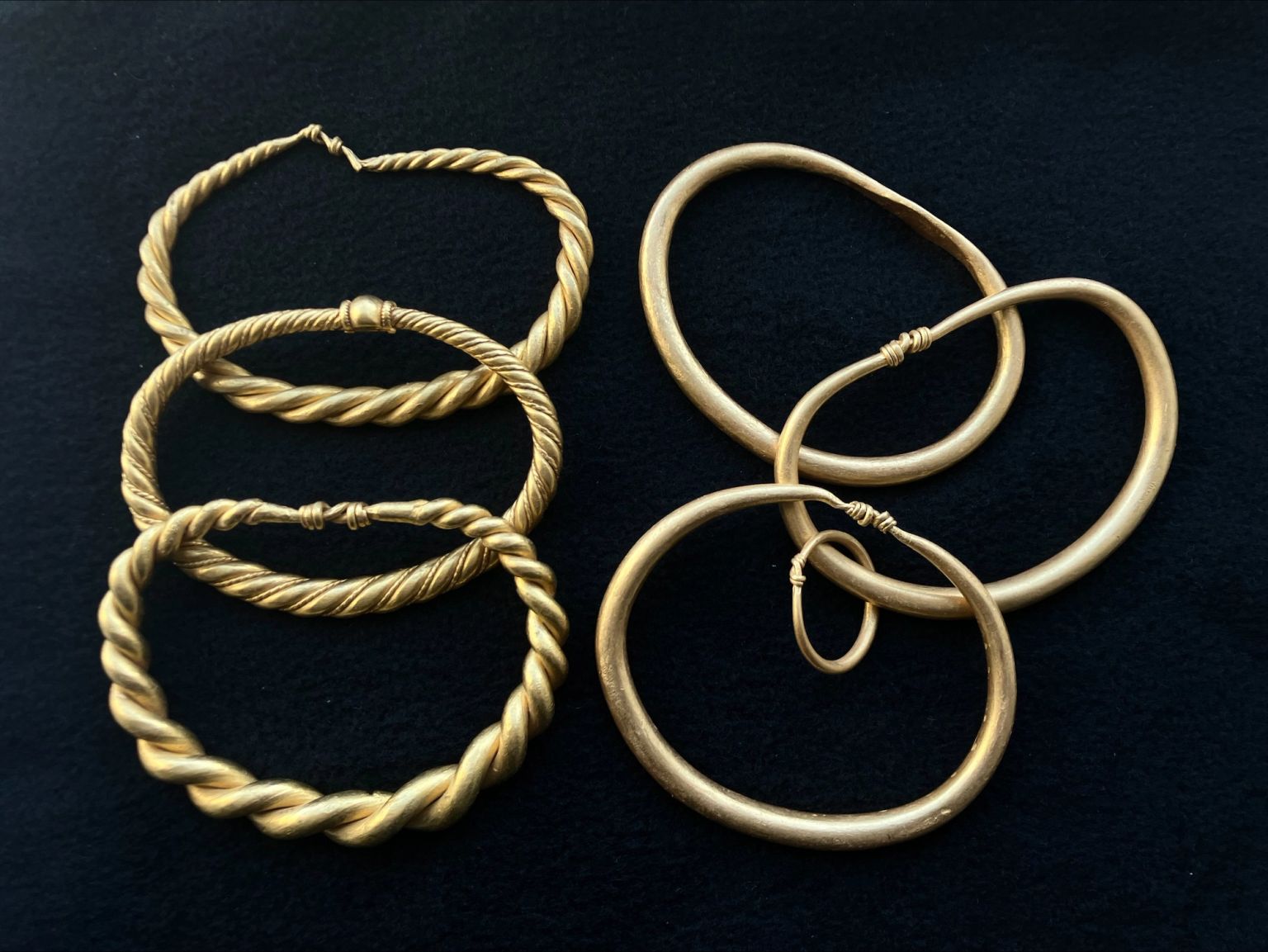
See a sensational Viking gold hoard
Six gold arm rings weighing almost 800 grams, found in May, are now on display at the National Museum of Denmark until the end of 2026. It began with a walk near Rold. A local resident from North Jutland spotted two gold arm rings lying exposed in the soil, glinting on a farm track. Archaeologists from the Museums of North Jutland were called in, and their investigation of the site soon revealed that there was more to come. Shortly afterwards, the archaeologists found four more gold arm rings. Together, the gold rings weigh almost 800 grams and represent one of the most remarkable gold finds from the Viking Age. The Rold Hoard, as it is known, is Denmark’s third-largest Viking Age gold find.
A brief introduction to the Rold Treasure
- Six intact gold bracelets.
- 762.5 grams of solid gold.
- From AD 950–1000.
- No. 3 among Denmark’s largest Viking Age gold finds. Surpassed only by the Tissø ring, found in western Zealand in 1977, and the Fæsted hoard near Ribe, discovered in 2016.
- Found near Rold in Himmerland.
- On display in the “Danish Prehistory” exhibition at the National Museum of Denmark in Copenhagen until the end of 2026.
- On loan from Nordjyske Museer
"The Rold treasure brings us closer to our ancestors"
“The Rold hoard is a discovery that brings us closer to our ancestors. You can look at objects that a powerful person wore or owned more than 1,000 years ago. And the story of how they were found is almost as fascinating as the gold itself. Just like when Kirsten, a peasant girl, stumbled upon the first Golden Horn nearly 400 years ago,” says archaeologist Kirstine Pommergaard, who handles treasure trove cases at the National Museum of Denmark.
The gold from Rold dates to AD 950–1000 and was buried during a period of upheaval in our history.
Royal power grew, the kingdom was unified, and Christianity spread. It was also a time marked by power struggles and major construction projects, such as Harald Bluetooth’s ring fortresses and the Jelling monuments.
Fine gold craftsmanship
Gold was not for just anyone. Arm rings were made of both silver and gold, but gold was rare, and only the very highest ranks of society owned it. These precious rings could symbolize their owner's wealth, status, and political connections.
The six arm rings also bear witness to highly specialized goldsmithing. Several of them are richly decorated.
Why was the gold hidden?
We do not know why the rings were buried. They were carefully stacked on top of one another, so everything suggests they were buried deliberately. Perhaps they were hidden from an enemy during a time of unrest, or perhaps it was a religious act—a gift to the gods.